Future-Proofing Minds: Why Early Cognitive Development Matters More Than Ever
We live in a time of extraordinary change. As technology advances and the global landscape evolves, we continually ask ourselves how best to prepare the next generation. Are we providing our children with the necessary tools, or are we merely educating them to memorise things that may become obsolete by the time they reach adulthood? MiniChess believes the solution lies in shifting our focus from what to think to how to think.
In a future when automation and artificial intelligence are reshaping the professional landscape, our children’s most asset will be their capacity to tackle complex, unique challenges. This is more than just academic success; it is about developing resilience, adaptability an most importantly, disciplined critical thinking.
When we consider the obstacles that young learners face today, we see an obvious need for neuro-based teaching techniques. We treat the brain like a muscle, which requires consistent, focused training to develop capability. This is at the core of all we do at MiniChess. We shift from rote learning to active, “clever brain-play” that helps children develop critical neural pathways.
We meticulously plan our approach to meet children at their developmental level. We recognise that optimal learning cannot occur while a youngster is in ‘survival mode’. We assist learners in entering their ‘thinking brain’ by providing an emotionally safe and engaging environment. Our Start Smart programme, created for 4- to 5-year-olds, addresses developmental backlogs by strengthening the vestibular, proprioceptive and kinesthetic systems. This is the foundation for long-term intellectual and emotional success.
As they develop, we continue their journey with our MiniChess Clubs, where weekly group instruction promotes not only chess skills but also social preparedness and collaborative problem-solving. It’s remarkable to witness these young minds master the five processes of critical thinking, assessing the problem, prioritising the critical point, developing a solution, implementing the plan, and re-evaluating the outcome, all while enjoying the game.
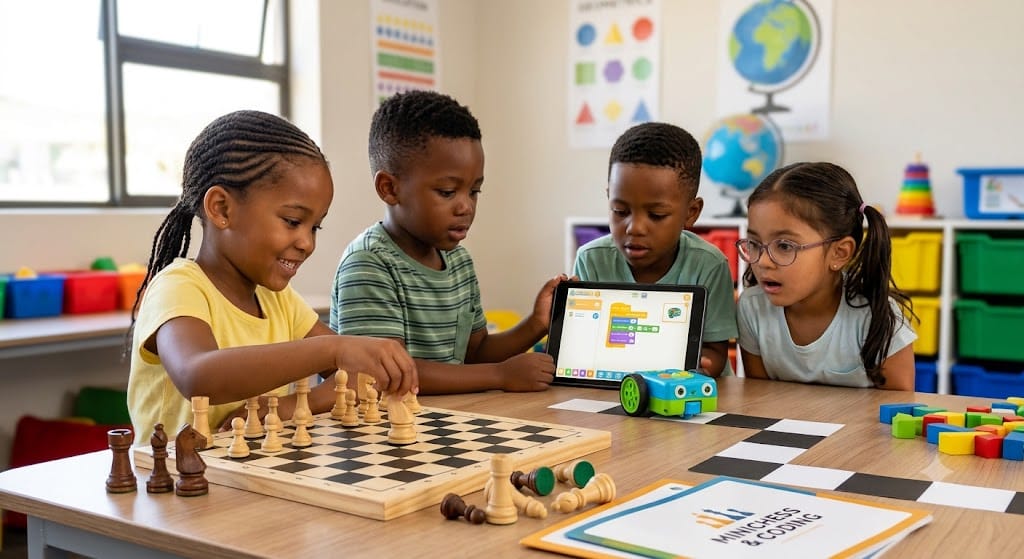
The digital future requires more than simply reasoning; it necessitates a comprehensive approach. That is why we are so enthusiastic about MiniChess and Coding programme. We understand that coding can be abstract for young learners, so we apply our unique methods to bridge the gap. We begin with concrete, three-dimensional learning and then move on to two-dimensional work and lastly to abstract application with Scratch. This is more than just teaching children to write code; it is also about instilling in them the spatial awareness, rationality, and perseverance required to succeed in STEM professions.
At MiniChess, we don’t just teach the game. We use chess to unlock potential, develop socio-emotional intelligence, and cultivate an entrepreneurial attitude. We are nurturing tomorrow’s leaders, innovators, and problem solvers.
If you want to offer your child a competitive advantage in this quickly changing world, we welcome you to explore our programmes and see how structured, play-based learning might help.